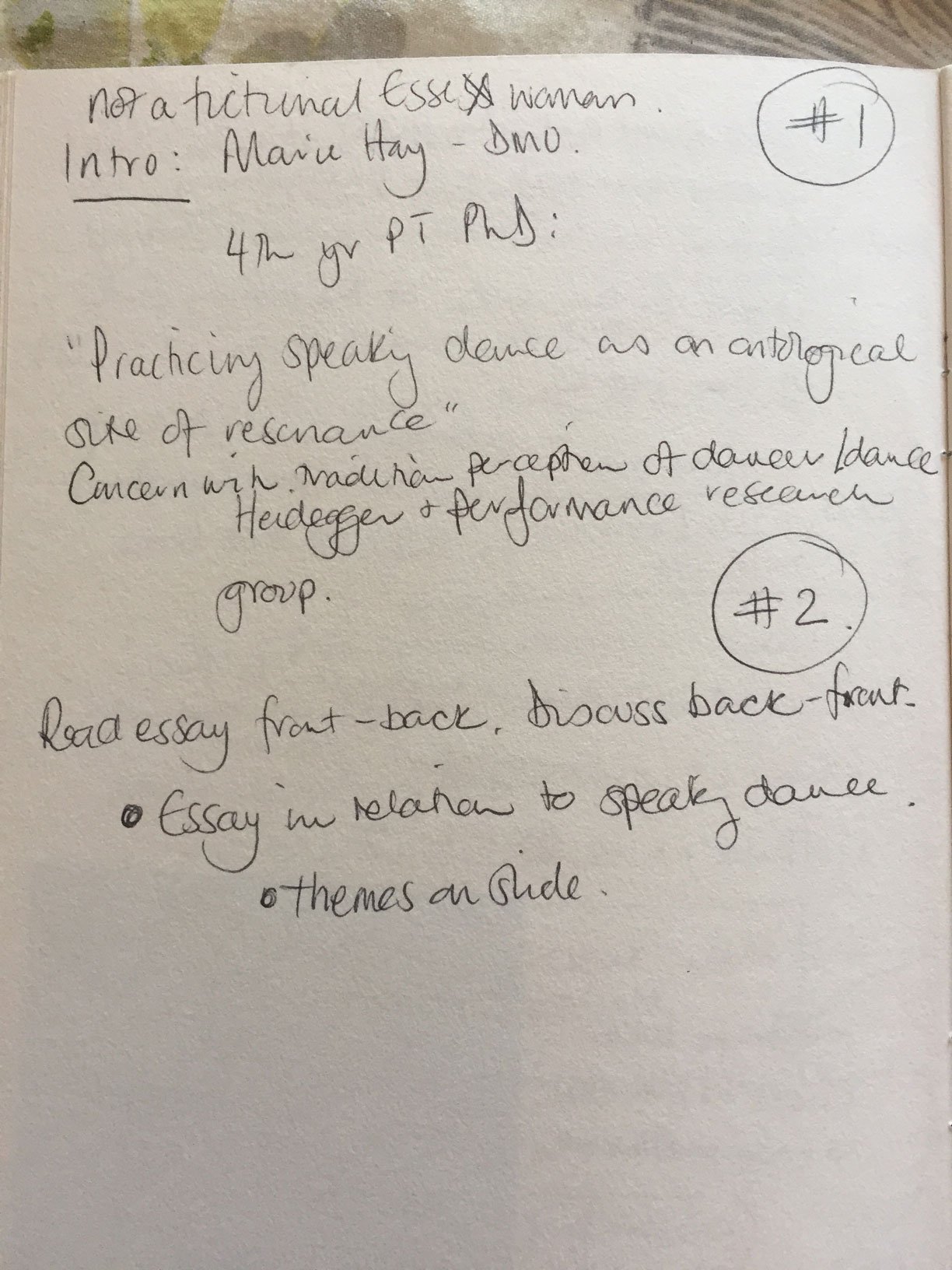
#1 Intro
My name’s Marie Hay. I’m a Senior Lecturer in dance at De Montfort University, Leicester. I’m also in the 4th year of my part-time PhD, currently titled: Practicing ‘speakingdance’ as an ontological site of resonance. The aim of this practice-as-research is to disclose the ontological possibilities of speech in contemporary dance. Autobiography and autoethnography underpin the approach to creating a collective resonance for the researcher and those who participate in sharings of practice and writings.
Concern with tradition perception of the dancer/dance.
My work with speech and dance grew out of the issues I had with the traditional perception of the dancer as a body and dance as an art form that comes from bodies. As a dancer, I took offence at being interpreted as moving meat, with my artform being regarded as existing only in flesh.
Heidegger and Performance research group.
Together with Martin Leach (De Montfort University) and Louise Douse (University of Bedfordshire), I created a Heidegger and Performance research group as part of the Performance Philosophy network. We will be hosting the From Heidegger to Performance symposium later this month at De Montfort, with a range of international speakers.
#2
Read essay front-back. Discuss back-front.
- Essay in relation to ‘speakingdance’.
- Themes on slide
I read Heidegger’s essay front to back, but will discuss it back to front in relation to my ‘speakingdance’ practice-as-research. The themes I will focus on are on the slide, but before I talk about those I think it would be useful for you to see a clip of my practice in performance.
Click slideshow to advance.
Language poetry and dance as art
p.56: ‘The belonging together of being and saying’
VOICE
Language and poetry come together because of the relationship of being and saying. Words are artistically voiced to disclose some truth of being. Words alone are not enough; an appropriate language needs to be created.
The quote reminds me of the work of Adrianna Cavarero, who writes about being and saying belonging together in a philosophy of voice. Voice is more than language. Voice comes from the performance of being from one to another. In ‘speakingdance’ the dancer’s voice comes from her saying and her being. She talks with words and dance, from her story to the narrative of another.
Being-with-others/creators and preservers
p.44: ‘The essential belonging together at work of creator and preserver’
p.40: ‘what is created cannot come into being without preservers’
In ‘speakingdance’, the art does not exist without the roles of creator and preserver as described by Heidegger. As the creator, I can engage with the practice, but the art of the practice lives in its time with preservers – during and following the performance, because the art of the practice is in what it discloses and what it becomes when it is being-with-others.
Unconcealment and truth – becoming
p.44: ‘Art is, then, a becoming and happening of truth’
Being & death
Like life. Art has its own being – born from its creator, becoming with others, who cannot know the truth of it until the sense of their togetherness ends. Heidegger writes about being and death in Being and Time and his thinking has resonated with me since my Mum passed away a couple of weeks ago. I’m choosing to share this with you today as it’s an important part of my narrative. My narrative is the starting place for practicing ‘speakingdance’, it’s where the voice originates from.
p.37: ‘The establishment of truth in the work is the bringing forth of a being of a kind which never was before and never will be again’
The event dies, like my Mum
My Mum’s passing followed my recent reading about being and death in Heidegger’s Being and Time. My Mum’s life is complete, our becoming together has ended. Lives and relationships finish and we know then all that they had to offer. Lives and relationships are events, like performances. They all die and then we know the truth of them, but only then, once they are gone. Our becoming must continue without that togetherness.
The practice of ‘speakingdance’ and ‘speakingdance’ performance events gives a voice to the dancer’s sense of being, the truth of which is disclosed through speech and movement by the end of the improvisation, to her and her observers. However, because the dancer, the audience and the artistic practice are becoming together, some truth of all of them is brought forth in the moment the event concludes.
In this unfolding of truth, where does the ‘art’ originate?
Not a fictional Essex woman.
I was born in Essex and lived there until I was 8 years old. By that time, I already owned a pair of white stiletto shoes. This is not a character created for performance, this is my narrative. I perform with my being.