First of all my warmest thanks to Sacha, Hester and Gareth for organising this rare event. It has offered me a unique opportunity to reread the Origin of the Work of Art and thus to reappraise the extent of its significance—for Heidegger’s own thought and more importantly for thinking about art, through and with art, even simply thinking art and, why not, ultimately crafting thought. I find it particularly important to read this text with you, here, today.
Heidegger’s essay, aside of an introduction, an afterword and an appendix,1 comprises of three parts: The Thing and The Work, The Work and Truth, Truth and Art. Read after each other, they show their repetitions as architectural synapses along which the essay’s reading is meant to travel: from the thing to the work to art. The passage lends the impression of an unshakable unity, which could readily assume a circular figure, if there were to be a fourth part: Art and The Thing. “One, two, three—but where, my dear Timaeus, is the fourth,” begins the famous Platonic dialogue on the craftsman, the demiurge.
The absence of the fourth is truly significant, but the question whether the line, or grammê is already bent, between the lines of Heidegger’s text, into a circle, must be—for now—suspended. We will not heed Derrida’s advice that opens his long, polyphonic reflection on The Origin, namely, that: “we should wait until there are even more than three of us.” Since after all there are clearly already more than three of us, we shall attempt to make some progress in this direction, by focusing on the first of the three parts: The Thing and the Work. It is here that the crucial juncture of thought and art is established, a juncture which is thus decisive for the support of the metaphysical weight of the subsequent parts.
It is perhaps no surprise that Shapiro’s and Derrida’s responses also focus on this part. I am quite certain that you are familiar with what assumed the name of a controversy over Heidegger’s text. In 1968, after a brief correspondence with Heidegger, Shapiro published a ‘Note’, which attempted to collapse Heidegger’s essay by pulling out what for Shapiro constituted the cornerstone of the Heideggerian edifice: the attribution of the shoes in Van Gogh’s painting to a peasant woman. With a series of external and internal hermeneutic claims, Shapiro purported to have established that the shoes had actually belonged to Van Gogh himself, a man of the city by the time of the painting. Shapiro, the Jewish art historian, accused Heidegger, the Nazi philosopher, of nothing less than projecting a Blut und Boden ideology onto the canvas. Although conducted with an almost ironic, apolitical, academic civility, the stakes of the reproach are clear. But it is only when the ideological struggle is suspended, that the full force of the wager becomes apparent.
It was Derrida’s Restitutions, published ten years later, that attempted to show how this wager eluded Shapiro. Only the most short-sighted reading could mistake Derrida’s gesture as a defense of Heidegger. Derrida’s radical querying of the method, assumptions and conclusions of Shapiro, intents rather to show that the latter is bound no less, perhaps indeed more, than the object of his critique to an attempt at restituting, attributing, referencing and consigning the pair of shoes to a living person beyond the confines of the canvas. What is questioned is the passage itself to the hors-tableau, the outside and beyond the pictorial, always the inscriptual.
I do not wish to play fourth, in the controversy of the three. The reason however I devoted some precious time on outlining a well-known picture, is in order to raise the question of Heidegger’s own passage to the hors-tableau. This is the hinge of the essay, the door through which Heidegger steps into the great outdoors of Being. 2 Does he actually need this door? Are there no other escape, or evasion, as Levinas might say, exits? Heidegger would have us believe that this door and this door alone is the right one. In this essay art—all art, which as we know is poesy, but in this instance also specifically painterly—art assumes here a unique status. Art conditions history, what will later become the history of Beyng. It is origin of the work, which work is always of the art, in this double, both subjective and objective genitive: a work that has specific qualities, which is, so to say characterized by art, but more importantly—this is Heidegger’s move—a work that belongs to art, to art as its origin and thus as its Wesen or essence.
(Be it noted in passing that despite all his attacks against the Latinisation of Greek thought and its ruination during the Middle Ages, Heidegger is relying on the Medieval distinction of essentia and existentia, when he opens the essay by defining origin, as the whence of what something is, as opposed to the whence of the fact that something is—Heidegger does not mention the second possibility in this instance. This has vast implications, since it is not the existence, but rather the essence of the work of art that will be throughout pursued—one of the implications accounts in part for the relative absence of the artist, Hester. I fear that the fact that a thinker with a profound understanding of the bankruptcy of this distinction, sets off tacitly from it in this essay, cannot be explained away as a mere pedagogic devise. End of the diversion.)
Art is here all and in a sense, a sense that I won’t be able to pursue directly, all appears to be art. But does Heidegger need art? If we could, I would wish us to stop, read and comment on Heidegger’s essay The Thing, written fifteen years after The Origin. Art has there disappeared. Unconcealment or aletheia is either of something that is already there (nature) or of something made (craft). And this is all. The jug, which features also in The Origin, is enough to draw together earth and sky, mortals and gods, into the famous Heideggerian fourfold ( Geviert), which for lack of time, we might say that encompasses what Heidegger in The Origin and during the years leading up to its composition, calls world. So there is no art in The Thing; and no shoes.
So the question, the greatest question is: does Heidegger need art? But then also, does he need painting, does he need Van Gogh and does he need this specific painting—‘one of many’, as Heidegger will say—by the latter? And then again—this is a separate question—does he need the shoes, or for that matter, the jug? Although Derrida’s Restitutions moves in the direction of these questions, it fails to explicate them.
My original intention was to do so today, by examining the interrelation of the thing, the equipment and the work and by proposing to approach certain works from within this interrelation. For I believe that—at the very least within the bounds of this essay—it is from the interrelation of the three that the status of the fourth, namely art, to be decided. Once again, I will have to confine my intention to a future hope. But that much, in a grain, is clear. After Heidegger examines three key historic figurations of the notion of the thing, namely the thing i. as hypokeimenon or bearer of properties, ii. as a sensuous manifold or object of perception and finally iii. as formed matter, and exposes their interconnected limitations, he proposes a maximal and a minimal understanding of thinghood: the first includes almost everything: gods and humans, the earth and the planets (Heidegger does not consider here numbers, theorems or for example the virtual); the other includes almost nothing: Heidegger, is left with a block of granite, as a half-satisfactory example. The first envelopes semantically, or even epistemologically, the equipment and the work, the second falls short of both. However, the latter, the thing-as-almost-matter, forms one of the poles between which equipmentality will find its place. To the other pole Heidegger will assign the work. 3
This arrangement is not only problematic because it replicates in a different register an archaic Platonist schematism, in which between the poles of base matter (the mere thing) and eternal forms (the pure work) one finds a mixture or composite ( synamphoteron) that constitutes lower human nature (here, bastard equipment). 4 It is twice as problematic, because it entails the need for a radical censorship, more severe than the Platonic, of what should qualify as work, a work that has access to the origin: art.
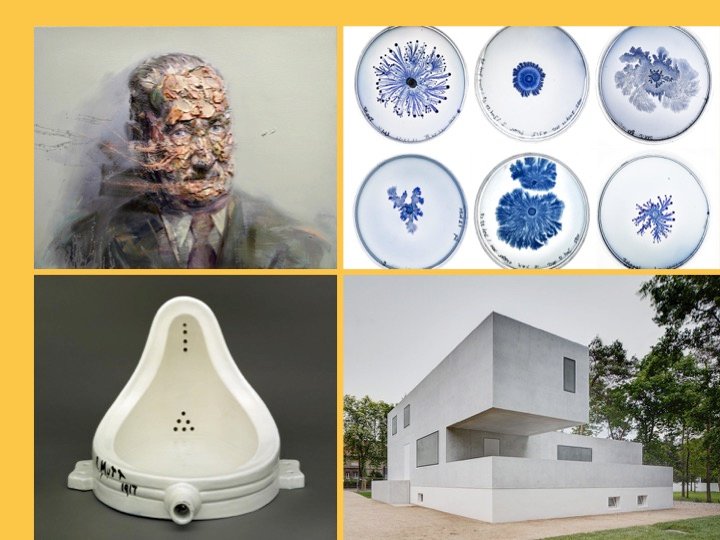
My aforementioned intention was to bring into the open of the discussion three instances that destabilise and militarise the tranquility and order of the Heideggerian text. The first would be Duchamp’s 1917 Fountain and for that matter all ready-mades. The second, the work of the Bauhaus school in the 1920s. It is beyond doubt that Heidegger was familiar with both, as he was with non-figurative art, a further domain of contestation as evidenced in an obscure footnote of the 1960s Reclam edition of The Origin. Lastly, I would like you to consider the challenge of biodesign, and a work such as Nurit Bar-Shai’s Objectivity. Drawing inspiration from Eshel Ben-Jacob’s study of microbial behaviour, Bar-Shai, manipulated colonies of Paenibacillus vortex, shaping their social motility into quasi-perfomative developmental patterns, before colouring and thus arresting the ensuing figures into fossilised sculptures. I am confident that you can glimpse were these three challenges, three or even perhaps four, are heading.
Thank you.
Georgios Tsagdis
London
03/08/18
1 Despite the textual silence of both the German and English editions appears to have been inserted upon the publication of the text in the collection of Holzwege.
2 The Meillassoux and Morton assonances are not merely fortuitous.
3 In the form of a bare diagram one could read: t — E — W — T.
4 One should think from this vantage point Arendt’s homo laborans.