Mark Titmarsh
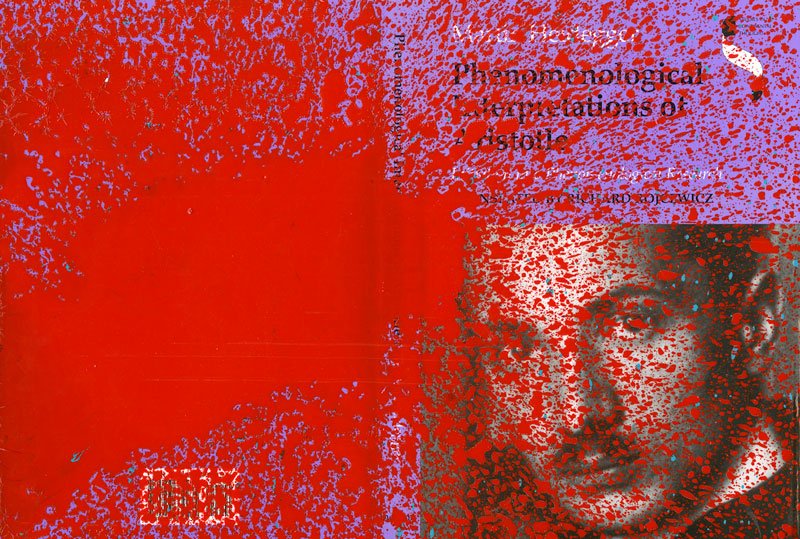
I want to propose that in Origin of the Work of Art Heidegger invokes a post aesthetics without him ever using that term. The derivation of our word ‘aesthetics’ comes from the Greek word aeisthesis, meaning to feel, sense or perceive. Thus we can say very generally that aesthetics is a study of the way we feel the world through the things that surround us, from works of art through to things of everyday experience. Aesthetics becomes a way of ‘feeling our feelings’ about the world, to find a way to articulate whether it be good and proper, correct and beautiful. When Heidegger turned his attention to art in the 1930s he sought out those parts of art and art making that aesthetics had not been able to reach or articulate, something indicated by aesthetics but beyond its reach.
He begins the search with a declaration about the primacy of art, “the question concerning art leads us directly to the one that is preliminary to all questions,” 1 the question of being. What is revealed in art, according to Heidegger, can be discussed in terms of two ontological dimensions, earth and world. He presents these two terms together for the first time in The Origin of the Work of Art 2 where they appear to operate as a substitute for the traditional aesthetic division of form and content and the phenomenological dyad of ground and horizon.
Even though ‘world’, was a major focus in Being and Time it is developed in The Origin of the Work of Art specifically in relation to the work of art. Most surprising is the term ‘earth’ since it has not appeared in any of Heidegger’s previous texts. In earlier texts Heidegger used the term ‘nature’ to signify an impenetrable ground 3, which is a primordial sense of nature, derived from the Greek 4 word for nature, phusis. Heidegger eventually drops any reference to nature and uses instead the term, earth, while retaining some of the connection to phusis.5 Earth is that which allows material presence, that which provides a ground on which the world can stand. Earth is inherently a duality since like phusis it is an ‘emerging flowering’ and a ‘withdrawing decaying’, that is both a presencing and absencing.
Being and Time showed that world is not a collection of entities and events but is an environment, a web of meaningful connections in which we are always immersed. Earth comes to operate as a vital agonistic term in relation to world. Through the term ‘earth’
Heidegger conceptualises the riddle of how something can be present and absent at the same time, how something might advance and withdraw simultaneously, be pres-absential.
Understood in connection with earth, worlds live and die. Civilisations set themselves up for eternity and become ruins, where earth provides the material for abundant success and the counter cycle of withering decay. World in its expansive inter-relatedness seeks to contain everything there is, to make it ‘intelligible’, to make it worldly. At the same time earth “shatters every (worldly) attempt to (capture) or penetrate it.” 5
As if this wasn’t enough, earth-thinking involves something even more, a recognition of a type of creativity on the side of nature, that matter is not an inert substance to be simply tamed and mastered. Earth suggests something further, it indicates the humid creativity of matter, partially waiting and partially driving forward from itself.6 To acknowledge the creativity of materials involves rethinking matter as a kind of “creative intelligence.”7 The creativity of matter is its plasticity, a “predisposition to movement, change, interpenetration and transformation.” 8 As Catherine Malabou develops it, “Being is nothing but its plasticity,” 9 the metabolism of being is its Ontological Plasticity. Plastic names both a substance and its ability to transform, it is an ontological onomatopoeia.
The artist harnesses some of the creative power of the material of earth to bring something into appearance, into presence, into form, to bring it out of itself, to disclose it, to enable a jutting through: “the world grounds itself on the earth and earth juts through world.” 10
Consequently “the work is neither an object nor a product,” 11 but a happening, an event, “a breach … crack or split … which defines an opening”12 through which “colour shines and wants only to shine.” 13
Art serves to make “the very shining of things apparent” 14 revealing as it does, “the undisclosed abundance of the awesome,” 15 and “a pure incalculable upsurge” 16 in all things. This shift in the conception of art demands both a new language and different conception of presence. Heidegger attempts both at the same time by virtue of a new quantum-ised language, parallel to Einstein and Joyce. Almost at the same time as the scientist and writer, he instigates a graphic philosopheme in the form of “word constellations, roots and etymological connections, prefixes… the hyphen (and crossing out)” 17 For us this might be captured in the journey from painting through painting to paynting.
1 Heidegger, Nietzsche, Volume 1, Harper, San Francisco, 1991, 142.
2 in Basic Writings David Krell (Ed), Routledge, London, 2002, 143-203.
3 for a detailed study of Heidegger’s shift in terminology and thinking from ‘nature’ to ‘earth’ see Bruce Foltz, Inhabiting the Earth : Heidegger, Environmental Ethics, and The Metaphysics of Nature, Atlantic Highlands, Humanities Press, 1995.
4 Heidegger continually returns to the Greeks to unearth an originary thinking that reminds us of what we have forgotten, and at the same time what the Greeks were unable to say. 5 Michel Harr, Song of the Earth, 1993, Indiana University Press, 48.
5 Heidegger, “Origin of the Work of Art”, in David Krell (Ed) Basic Writings, London, Routledge, 2002, 175.
6 reminiscent of the “self flourishing” discussed previously in relation to phusis.
7 Paul Carter, Material Thinking: The Theory and Practice of Creative Research, Melbourne Uni Publishing, Melbourne, 2004, xiii.
8 ibid., 187.
9 Plasticity at the Dusk of Writing, Columbia Uni Press, NYC, 2020, 36.
10 Heidegger, Origin of the Work of Art”, 174.
11 Jacques Taminiaux, “The Origin of ‘The Origin of the Work of Art’”, in Poetics, speculation, and judgment : the shadow of the work of art from Kant to phenomenology, SUNY Press, Albany, 1993, 165.
12 Gregory Schufreider, “Origin of the Work of Art”, In Francois Raffoul & Eric S. Nelson (eds.), The Bloomsbury Companion to Heidegger, Bloomsbury, London, 2013, 203.
13 Heidegger, “Origin of the Work of Art”, 172.
14 Michel Haar, “Heidegger and the Nietzschean Physiology of Art” in Exceedingly Nietzsche: Aspects of Contemporary Nietzsche Interpretation, David Krell and David Wood (Eds), Routledge, London, 1988, 20.
15 Heidegger, OWA, 201
16 Michel Haar, “The End of Distress: The End of Technology?” Research in Phenomenology, Vol 8, Brill, Leiden, 1978, 54.
17 Krzysztof Ziarek, Language after Heidegger, Bloomington, Indiana University Press, (2013), 6-8.