When I came to reread the essay for this I was coming to it through the lens of a book project on imprints and traces – images made by contact. Specifically via some recent work on paleolithic cave art and the uses to which it gets put in post-war French poetry and thought. Since the discovery in 1940 of the prehistoric cave-paintings at Lascaux, and their opening to the public in 1948, writers including Georges Bataille, Maurice Blanchot, Julia Kristeva, Marguerite Duras and René Char have used these images as the basis for philosophical, literary and cinematic reflections on humanness, animality, violence, sacrifice, solitude, creativity – and the origin of the work of art. In the context of these reflections, one image has a particular status – the handprint, usually a negative stencil, which often appears alongside paintings of animals in caves art of the upper paleolithic era and after.
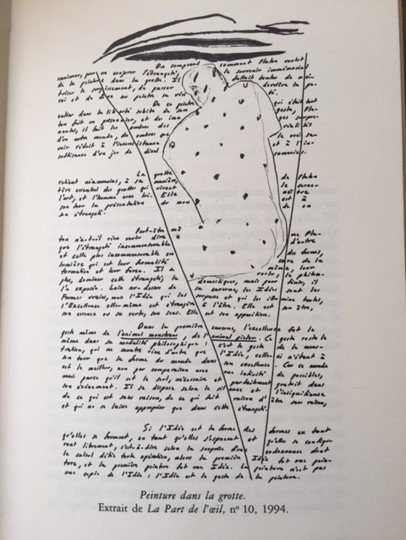
One of the most recent French writers to engage with this image is the philosopher and great reader of Heidegger Jean-Luc Nancy. Nancy’s text ‘Peinture dans la grotte’, was first published in 1994 an issue of La Part de l’oeil on Georges Bataille and aesthetics. In that publication Nancy’s text appeared in manuscript form, with line drawings by the artist François Martin:
It was published in revised form and in standard typeset later that same year in the collection Les Muses.
In this short essay, Nancy stages an imaginary scene – a primal scene – the creation of the first work of art. I want to present it briefly here because it seems to instantiate something central to the ‘Origin of the Work of Art’, implicitly albeit knowingly. I found it helpful to think through Nancy’s account of this scene through the specific argument of OWA, but it also crystallises some interesting questions about that essay. So, I’m going to briefly outline Nancy’s account and how I think it illuminates key arguments of the OWA, then close with some of these questions, depending on how the time goes.
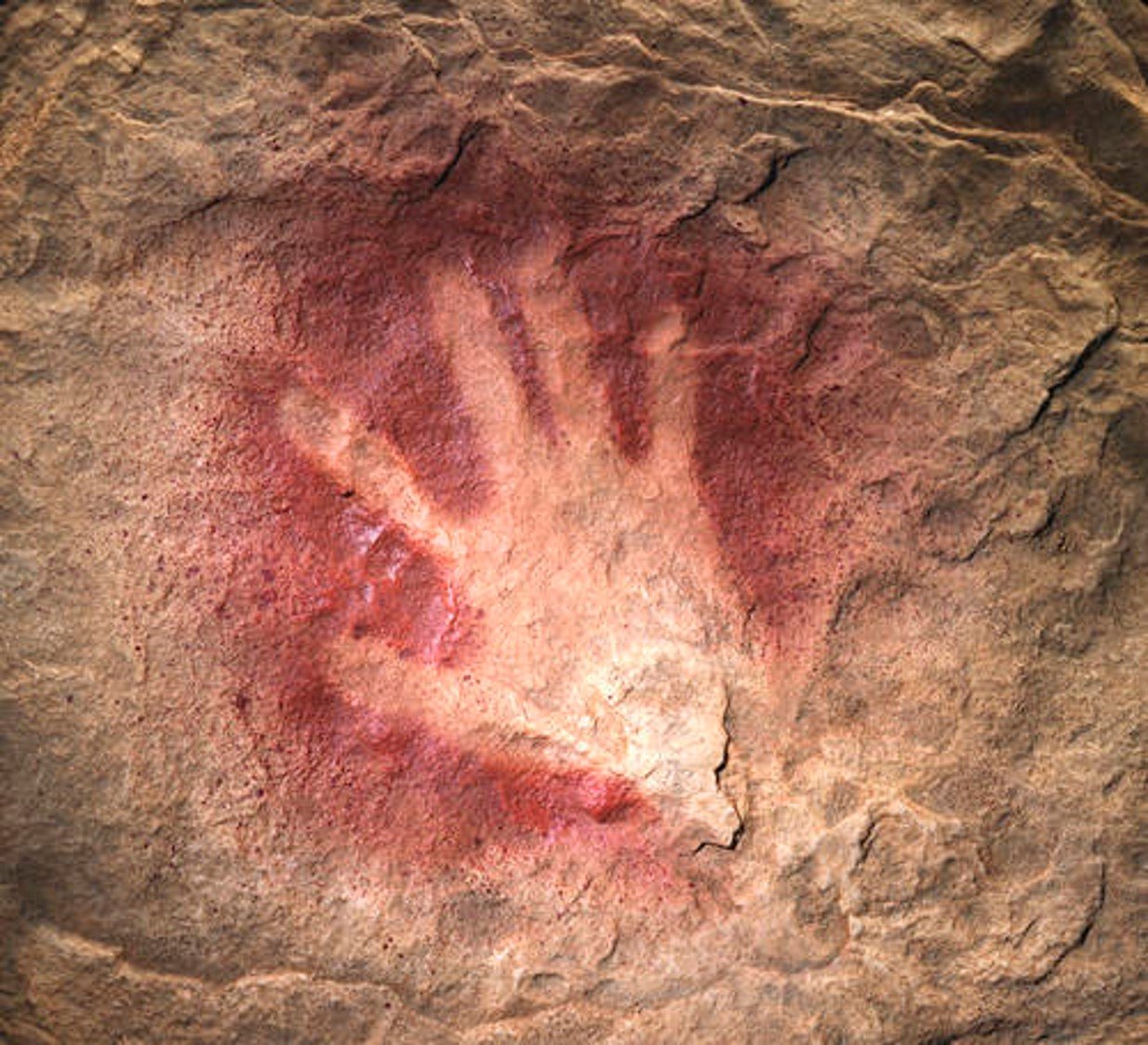
‘Painting in the Grotto’ is Nancy’s account of the founding gesture of art as an act of presentation, showing or monstration. Unlike earlier philosophical readers of the cave such as Bataille or Blanchot (who fixed mainly on the human and animal figures), Nancy focuses his attention on the hand stencil, and he describes its fabrication accurately:
‘The traced hands, probably with the help of some stenciling technique
(what are called “negative hands”), which are today the earliest known
paintings (Cosquer Cave, and elsewhere hundreds of hands that are a little more recent), next to animals and various signs, these hands present nothing other than presentation itself, its open gesture, its displaying, its aperity, its patefation – and its stupefaction.’
For Nancy, as for other readers of such imagery, this kind of mark is a self-presentation [‘I was here’], but importantly, it is also a presentation of the act of presenting. Nancy emphasises the role of touch in his account of the making of such a mark, imagining it as a new kind of encounter between the human individual and the being of the things that surround him (or her – Nancy’s human is ‘man’, but research suggests many of the marks were made by women and children). :
‘The hand posed, pressed against the wall, grasps nothing. It is no longer a prehensile hand, but is offered like the form of an impossible or abandoned grasp. A grasp that could as well let go. The grasp of a letting go: the letting go of form.’
The gesture that brings the image into being is a non-instrumental touch; it grasps nothing, does not reach for the object as a tool. Indeed, Nancy places the origin of art not in the moment at which this non-appropriating gesture leaves a trace in the form of an image, but in the touch itself, in the gesture of touching the cave wall in this way:
Let us imagine the unimaginable, the gesture of the first imager. He proceeds neither at random nor according to a project. His hand advances into a void, hollowed out at that very instant, which separates him from himself instead of prolonging his being in his act. But this separation is the act of his being. Here he is outside of self even before having been his own self, before having been a self. In truth, this hand that advances opens by itself this void, which it does not fill. It opens the gaping hole of a presence that has just absented itself by advancing its hand. ‘
Even before the making of a mark, the human being’s touch is itself a kind of showing, in that it creates a ‘distance of presentation’, estranging the human from itself, and bringing into exisence a world that is not the universe of non-signifying being, but a world that is present as disclosed to human consciousness – in Nancy’s terms as ‘sense’.
For the first time, he touches the wall not as a support, nor as an obstacle or something to lean on, but as a place, if one can touch a place. Only as a place in which to let something of interrupted being, of its estrangement, come about. The rock wall makes itself merely spacious: the event of dimension and of the line, of the setting aside and isolation of a zone that is neither a territory of life nor a region of the universe, but a spacing in which to let come – coming from nowhere and turned towards nowhere – all the presence of the world.
It is touch, as the creation of a space, the delineation of a distance of showing that founds art, and brings into being the human as ‘animal monstrans’.
The terms are different, but Nancy is very close to Heidegger here. One way of understanding this coming into being of the artwork before it is even present as image, is as a passage, or an instance of strife, between earth and world. The rough rock wall becomes a space in which ‘world’ can come about, even as its obstructive impenetrability threatens always to withdraw into concealment, non-disclosure. If Nancy is describing a primal scene of the Heideggerian artwork, it is in its nature as emergence, unconcealment, the possibility of intelligibility which is nonetheless finite and always grounded on the resistance of earth to becoming intelligible.
This act of touching that makes image-making possible is also described in ways that resonate with the way in which Heidegger describes the making of a the work. The artist ‘proceeds neither at random nor according to a project’. The work comes about from via the intervention of the human, but that intervention is not the imposition or projection of a subjective form onto an object. This artist is not yet a subject, the wall not yet an object. The artist (who comes into being as artist in this very gesture), makes space for something of the world to emerge into intelligibility, but the presence of the world simply comes to presence of its own accord.
So far, so Heideggerian. But some questions remain.
[slide] Is this a work of art, in Heidegger’s sense? There is a body of aesthetic and art historical scholarship that says it isn’t, and in a way it’s a kind of limit-case for art. The first image, but not a representation in the sense of a depiction. Yet Nancy seems to present it as containing all the potential for every work of art to come.
Heidegger’s non-aesthetic understanding of the work of art is useful here. I can’t help thinking that something about the pure, basic, binary image-ground relationship actually figures the very strife that characterises the work for Heidegger – the coming and going, appearance and seclusion or recession that are always in operation in the work.
The problem of origins. Nancy treats this imagined first making of an image as a primal scene in the Freudian sense. It’s the moment of our origin from which we are always necessarily excluded. Nancy’s imagining of it is knowing in this sense – it’s a deliberately constructed figure, a myth, a fantasy of origin that works to explain what he thinks every act of presentation does. But Heidegger has a primal scene of art too, and for all that he insists on the historicity of all art, his mythical Greece bears a heavy burden of exemplarity. Both Heidegger and Nancy are ultimately interested in ontological ‘origins’ which originate every work, as much as they originate the category of the work of art. But in going back into the exemplary darkness of the cave, and doing so through this playful imaginary dramatisation, Nancy leaves no ground in his account for any narrative of a ‘real’ historical narrative – still less of any kind of fall.
The ‘secondness’ of the hand stencil. The fact that this uncoded, indexical representation is the origin of art for Nancy sets a low bar that paradoxically enables the kind of phenomenological engagement Heidegger wants us to have with the work. For Nancy, in this account, the creation of a work of art is nothing other than an interruption – a moment of estrangement of being from itself.